Affiliates program
 Login
Login


In Canada, as elsewhere, legal requirements around personal data protection compel organizations to structure their practices and to be transparent with users about how their data is handled.
In this context, the CMP (Consent Management Platform), more commonly known as the cookie banner, has become a key point of contact in the user journey. It is both a visible marker of trust toward a brand and a technical component that can influence web performance, particularly search engine optimization (SEO).
Sitegrow, a Canadian agency specializing in search engine optimization and GEO (content optimization for AI-powered generative search engines), supports companies throughout the design and development of their websites. This process necessarily includes compliance with applicable regulations (Quebec’s Law 25, Canada’s PIPEDA, Californian CCPA, European GDPR...) through the integration of the Axeptio CMP across its client portfolio.
In this article, Sitegrow and Axeptio jointly examine the links between consent, performance, visibility and user experience, with a specific focus on SEO and GEO.
.png?width=1600&height=900&name=Visuels%20Sliders%20Blog%20(4).png)
Law 25: A New Privacy Framework for Quebec-Based Websites
Since its adoption in September 2021, Quebec’s Law 25 has significantly reshaped the province’s approach to personal data protection. Inspired by the European GDPR, it strengthens requirements around transparency, accountability and individual control over personal information.
The law sets out strict conditions for consent: it must be explicit, free, informed, specific and granular. Organizations must also clearly inform users about the purposes of data collection, retention periods, and the transfer of information outside Quebec. These obligations apply across the entire lifecycle of personal data — from collection via cookies and other trackers, to storage, sharing, deletion or, in narrowly defined cases, anonymization.
Compliance under Law 25 is therefore an ongoing process rather than a one-time exercise. It requires appropriate tools and a proactive approach to data governance, both to secure personal information and to build lasting user trust. In this context, using a CMP becomes a practical necessity. It allows organizations to meet regulatory requirements while offering users a clear and accessible interface to exercise their rights, and to document their practices in the event of an audit.
Compliance and Performance: A Quebec Case Study
In practice, compliance efforts can also highlight broader performance issues — as illustrated by Sitegrow’s work with a Quebec-based professional services firm.
One of Sitegrow's client generated more than 4,000 organic visits per month, but was facing technical performance challenges at the time Law 25 came into force. Page load times were high, particularly on mobile devices, leading to user drop-off before content was even accessed.
Against this backdrop, the client was concerned that adding a CMP would further degrade performance by introducing an additional technical layer.
As an agency, Sitegrow adopted a different approach, integrating the Axeptio CMP as part of a broader web performance optimization strategy. The implementation prioritized the loading of elements essential to page display, while the execution of other scripts was conditioned on the collection of user consent. At the same time, several unnecessary third-party scripts, which negatively affected performance, were removed.
This combined approach led to a significant improvement in site loading speed. Bounce rates decreased on key pages, and organic traffic increased by 18% over a four-month period. The site is now both compliant with regulatory requirements and technically more efficient
“Honestly, we were stressed about adding a CMP. We thought it would slow the site down and create friction. Sitegrow did the opposite: they used it as an opportunity to optimize everything. Now the site is fast, we’re compliant, and customers can feel it. It’s reassuring for them.” - Patrick P., Marketing Director
CMPs, Web Performance and Core Web Vitals
Understanding Core Web Vitals
Web performance refers to a website’s ability to load quickly, remain stable, and respond smoothly to user interactions. These factors directly affect the browsing experience and, indirectly, a site’s visibility in search engines.
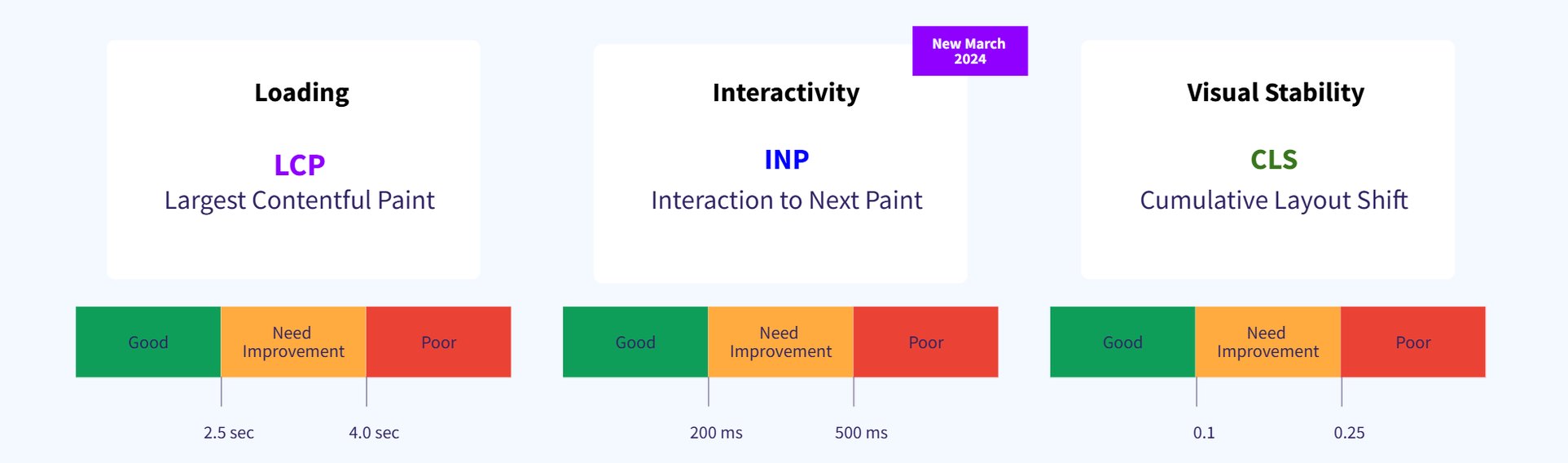
To assess this, Google relies on a set of indicators known as Core Web Vitals, which measure three key aspects of user experience:
-
LCP (Largest Contentful Paint): the time required for the main content of a page to load. A result under 2.5 seconds is considered satisfactory.
-
INP (Interaction to Next Paint): how quickly a page responds after a user interaction such as a click or text input. A value below 200 milliseconds is considered acceptable.
-
CLS (Cumulative Layout Shift): a measure of visual stability during loading and navigation, which degrades when elements move unexpectedly.
Why CMPs Matter for Web Performance
A CMP is one of the first scripts executed when a page loads. It intervenes early in the user journey by determining whether other tools and scripts are allowed to run based on the user’s consent.
As a result, its configuration, integration and loading strategy can have a direct impact on overall site performance and on Core Web Vitals.
At Axeptio, work on CMP performance focuses on reducing script size, optimizing server response times and controlling display behavior, with the aim of limiting any negative impact on Core Web Vitals.
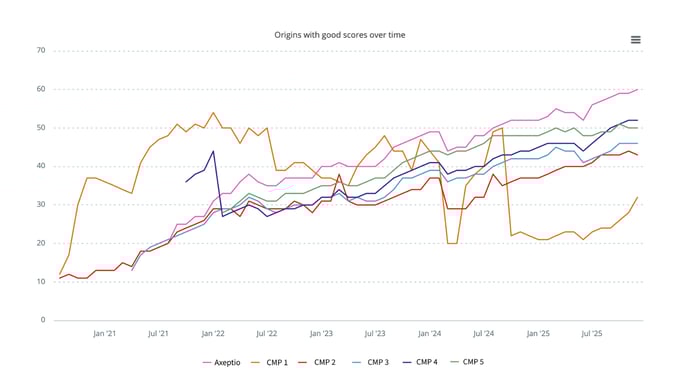
A dedicated article on this topic is available on our blog.
SEO, EEAT and GEO: Trust as a Shared Visibility Signal
SEO and GEO: Two Approaches to Online Visibility
Until recently, website visibility was primarily understood through the lens of traditional search engines, whose algorithms consider technical performance, content quality, site structure and user trust signals.
With the rise of tools such as ChatGPT, Gemini, Claude and Perplexity, prompt-based search is growing rapidly. Brands are increasingly seeking to be referenced directly in the responses generated by these systems.
This emerging field is known as GEO (Generative Engine Optimization). Its objective is to ensure that content is identifiable, understandable and potentially cited by AI-powered generative search engines.
These systems aggregate, synthesize and reformulate content from multiple sources, placing importance on perceived reliability, consistency of information and the credibility of the sites they draw from.
These principles closely echo Google’s EEAT framework (Experience, Expertise, Authoritativeness and Trust), which serves as a reference for evaluating content quality and site reliability in SEO.
EEAT and GEO: An Evolving Landscape
In the case of generative AI engines, evaluation criteria remain fluid. Technology providers communicate little about how sources are selected or weighted, and no formal framework equivalent to EEAT has yet been publicly defined.
However, a general trend is emerging: these systems tend to rely on content that appears reliable, coherent and attributable to identifiable sources demonstrating a degree of editorial rigor and responsibility.
From this perspective, traditional trust signals — regulatory compliance, transparency and site stability — form a common foundation shared by both SEO and GEO.
Within this broader set of indirect trust signals, the CMP stands out as a visible element. It reflects a site’s approach to responsibility and transparency, making data practices understandable to users and contributing to a relationship of long-term trust.

.png?width=427&height=213&name=Miniature%20B2%20%C2%B7%20Version%20retenue%2c%20ajust%C3%A9e@2x%20(2).png)
.png?width=427&height=213&name=Interflora%20x%20Axeptio%20(1).png)