Affiliates program
 Login
Login


Travelers’ new priorities are reshaping the digital experience
In the travel industry, customer behavior has changed significantly. Health, geopolitical, and economic crises have heightened the need for reassurance, flexibility, and transparency. Travelers want to be able to plan their trips independently, compare offers, access attractive prices, and still receive support when they need it. In this context, user experience has become a key driver for tourism brands: it must simplify search, help travelers picture their future trip, and provide reassurance before purchase.
With this in mind, TUI France has undertaken a broader review of its digital journeys, from its website to its new mobile app. Designed as a true travel companion, the app brings together essential information, bookings, schedules, useful contacts, and on-site services. It reflects the growing role of UX in TUI France’s strategy: combining the long-standing quality of its travel offers with more personalized journeys that better match today’s user habits.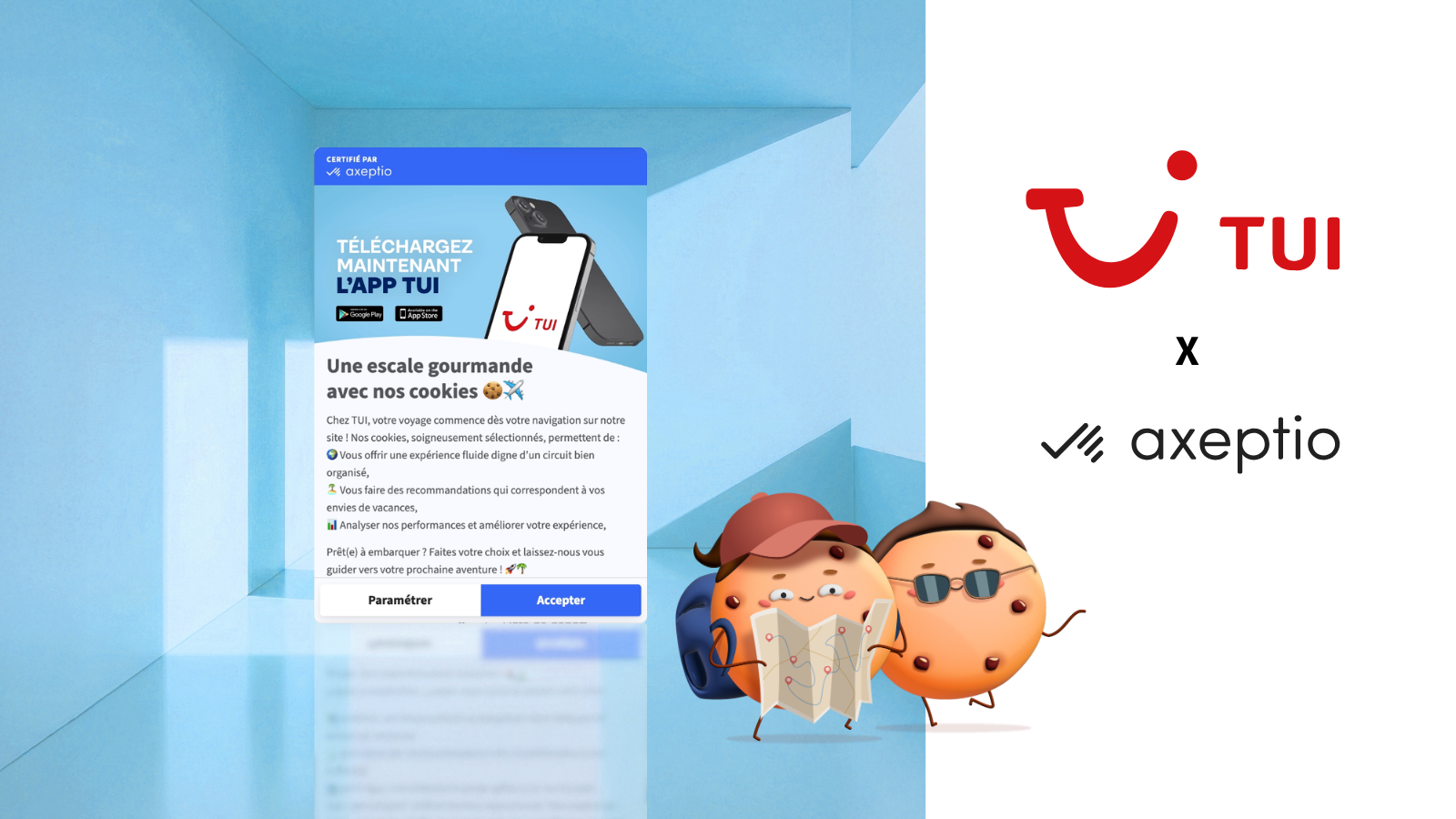
The cookie banner becomes a first moment of digital hospitality
With Axeptio, TUI France chose to customize its CMP and turn it into a first welcome message, fully aligned with its brand universe and echoing the sense of hospitality found across the travel leader’s 1,200 physical agencies. The wording draws on the codes of the travel industry, purposes are explained simply and clearly, the design fits naturally within TUI France’s visual identity, and the banner is triggered in a way that gives visitors time to arrive on the site before inviting them to make a choice.
Consent, Data and Performance: a Flywheel for Better UX
This white paper highlights the strategic role of consent in data quality. To manage an increasingly broad offering, analyze friction points, prioritize web development, and optimize campaigns, teams need to rely on high-quality signals.
Over the past 12 months, TUI France has recorded a 71% interaction rate, a 78% consent rate, and a 55% opt-in rate.
These figures show that a customized CMP can contribute to a virtuous cycle: the clearer and more consistent the experience, the more users interact and give consent; the more actionable data becomes available, the more teams can improve UX, personalization, marketing performance, and, ultimately, opt-in volumes.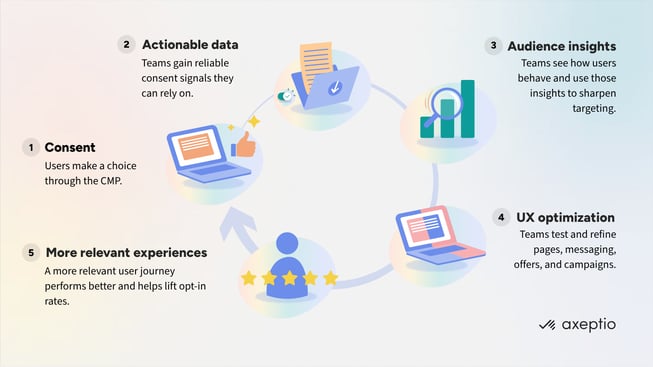
The CMP as a New Media Channel to Promote the Mobile App
The TUI France case also highlights a new use case for the CMP: as a contextual media channel. Thanks to native video integration within the cookie banner, TUI France was able to promote the launch of its new mobile app directly to website visitors. This format gives visibility to a strategic service very early in the user journey, while reusing creative assets already produced for other marketing campaigns. The CMP therefore becomes a space for brand expression, capable of supporting a product launch, a seasonal campaign, or the introduction of a new service.
The CMP is becoming a new media channel through which we can highlight the new services available to our customers. We used it for the launch of our mobile app, and we are considering using it again to celebrate the arrival of ANCV Connect, which will allow customers to use their holiday vouchers in digital format. The cookie banner offers a new channel for showcasing a feature or service without being perceived as overly promotional.”
Hélène Chabidon Hélène Chabidon, Product & UX Manager at TUI France

This approach invites brands to rethink the role of consent in the digital experience. It is no longer only about collecting a compliant choice, but about designing a useful moment that is aligned with user expectations. In travel, where hospitality begins from the very first moments of browsing, the cookie banner can become a space for welcome, trust, and conversion.
Download the white paper using the form on this page and discover how TUI France uses Axeptio to transform its CMP into a driver of UX, data quality, and marketing performance.

.png?width=427&height=213&name=Miniature%20B2%20%C2%B7%20Version%20retenue%2c%20ajust%C3%A9e@2x%20(2).png)
.png?width=427&height=213&name=Interflora%20x%20Axeptio%20(1).png)