Affiliates program
 Login
Login


Today, a Consent Management Platform (CMP) must simultaneously help companies comply with data protection regulations, preserve website performance, collect reliable data, while also aligning with brand identity, and offering a smooth user experience.
In other words, the best CMP is one that enables the collection of clear, traceable, and compliant consent while avoiding unnecessary user friction and compromises for marketing teams.
In this guide to choosing the best CMP in 2026, we have selected 5 market leaders. We compared them based on criteria that matter to acquisition leads, digital marketers, lead analytics, and traffic managers: customization, user experience, international multi-regulatory compliance, impact on web performance, ease of integration, and the ability to adapt to brand identity.
If you are looking for the best CMP for your organization, this comparison will help you choose a solution truly aligned with your business challenges and brand constraints.
.png?width=653&height=367&name=CMP%20Comparatif%20(1).png)
What is a Consent Management Platform (CMP)?
A CMP (Consent Management Platform) is a platform that allows for the collection, storage, and transmission of user consent choices regarding cookies, trackers, and other personal data processing on a website or mobile application.
Among other things, a CMP must enable:
- Displaying a cookie banner to collect consent.
- Giving users a clear choice between acceptance, refusal, and personalizing their choices per vendor.
- Communicating the different purposes of the trackers.
- Blocking non-essential technologies until consent has been given.
- Keeping proof of consent to meet regulatory requirements.
- Transmitting consent signals to analytical and advertising tools.
- Handling updates to user consent over time
In 2026, a CMP plays a central role for marketing teams. It stands at the intersection of several strategic issues: regulatory compliance, user experience, marketing, data governance, traffic acquisition, and digital performance.
This is particularly true for companies that must today reconcile several legal frameworks or technological standards, such as the GDPR in Europe, the CCPA in the United States, Law 25 in Quebec, Google Consent Mode v2, IAB Europe’s TCF v2.3, or internal requirements related to brand image and data management.
Choosing Your CMP in 2026: Features, Labels, and Customer Reviews
Not all CMPs are equal. Some are designed solely for compliance, others for large international organizations, and others for ease of implementation. If you are looking for the best CMP in 2026, here are the criteria that make sense for achieving your business goals.
1. Prioritizing Compliance
A good CMP must meet the main regulatory requirements applicable to your business: GDPR in Europe, CCPA and the GPC standard in the US, Law 25 in Quebec, nLPD in Switzerland, etc. Each regulation has its own specificities; therefore, if you operate internationally, it is important to choose a CMP capable of adapting to the different nationalities of your audiences. Labels and certifications exist to help you evaluate the credibility of different solutions, such as the Google CMP Partner Program, which ranks solutions into three levels (Gold, Silver, and Bronze).
2. Customizing Design and Experience
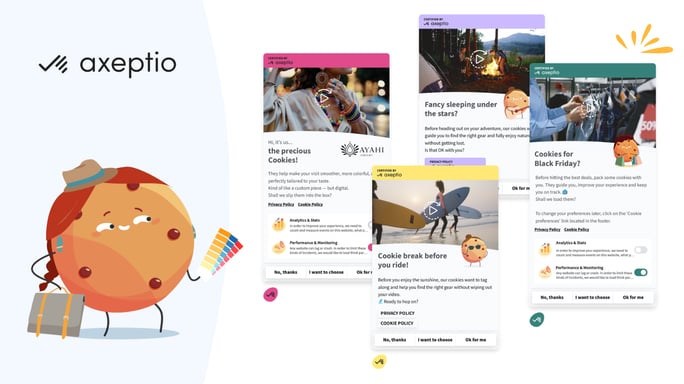
This is one of the most important criteria today, as it has a direct impact on the consent rate. A high-performing CMP must allow the banner to be adapted to your visual universe, your brand tone, and your UX constraints. Colors, typography, wording, layout options, display modes, visual hierarchy, accessibility, mobile fluidity: all of these influence the user's perception of your banner and help them better understand the stakes of consenting or not to the sharing of their data.
3. Aligning with Brand Image
The consent banner is one of the first brand touchpoints for a visitor. The most demanding brands are now looking for a CMP capable of transforming this regulatory moment into a consistent experience with their branding, so as not to ruin efforts made in customer onboarding and to feed the brand's storytelling. This turns a legal constraint into a positive part of the user journey.
4. Providing an Intuitive Back-Office for All Teams
Consent management involves multiple stakeholders: IT for integration, Marketing for acquisition, Data for tracking, and DPOs for legal risk management. When choosing a CMP, it is essential that the back-office interface is accessible to all team members, regardless of their technical expertise.
5. Minimizing Impact on Web Performance
The best CMP should never slow down your site. From script execution to its influence on Google’s Core Web Vitals, web performance is a critical factor in 2026. A lightweight, optimized solution is non-negotiable for SEO and user retention.
6. Ensuring Integration and Compatibility with Your Stack
Your CMP must sync perfectly with your analytics tools, tag management systems (TMS), CMS, and e-commerce platforms. Whether you are managing mobile apps or multi-domain environments, the solution must fit into your existing ecosystem without friction.
7. Scaling with Your Growth
A startup’s needs differ vastly from those of a multinational corporation. Evaluate the solution’s ability to handle increasing complexity: multi-site management, international regulations, multi-device support, and dedicated customer success. G2 reviews are a reliable way to gauge how a solution scales for large-scale operations.
8. Balancing Compliance with Business Growth
Ultimately, the best Consent Management Platform is the one that finds the right balance between legal requirements and business goals. A CMP should not just protect the company; it should support a trust-based digital strategy that enhances transparency and improves the quality of user interactions.
2026 Comparison: Top 5 Best CMPs
Before we look at the detailed analysis of each CMP’s strengths, and to help you quickly identify the best CMP for your needs, we have summarized the main differences between these solutions in the table below, highlighting their positioning, certification level, and overall rating based on user reviews.
| Solution | Reviews (G2) | Main Positioning | Google CMP Partner Program |
| Axeptio | 4,8 / 5 | UX and Advanced Customization | Gold |
| Usercentrics | 4,2 / 5 | Data Marketing | Gold |
| iubenda | 4,5 / 5 | All-in-one Legal Suite | Gold |
| Didomi | 4,5 / 5 | Advanced Implementation | Gold |
| Enzuzo | 4,6 / 5 | Operational Privacy Management | Gold |
Axeptio
.png?width=684&height=393&name=Macbook-Air-www.axept.io%20(3).png)
Axeptio is a CMP widely recognized for its UX-first and brand-centric approach. The solution was specifically designed to transform the consent step into a powerful marketing lever. The platform stands out through its advanced customization features: companies can tailor the design, message, and display formats, even integrating images or video, to ensure the banner feels like a native part of the user journey. This focus on building trust directly correlates with optimized opt-in rates.
Axeptio enables businesses to maintain compliance across all major global regulations, including GDPR, CCPA, and Quebec’s Law 25. As a member of the Google CMP Partner Program, it is fully compatible with industry standards like IAB TCF v2.3, featuring a dedicated "Pay or Consent" module designed for both transparency and ease of use. Marketing teams also benefit from advanced analytics directly within the backend to monitor and refine consent performance.
Additionally, Axeptio offers complementary tools like Terms, which extends consent management to all contractual documents, including privacy policies, Data Processing Agreements (DPAs), and legal notices.
Axeptio’s Key Strengths:
- Advanced banner customization (e.g., video support).
- Global compliance with all major international frameworks (GDPR, CCPA, Law 25).
- Native support for Google Consent Mode v2 and IAB TCF v2.3.
- Easy to implement via GTM, CMS (Shopify, WordPress, PrestaShop), or direct hardcoding.
- Top-tier Customer Success, rated "Best Support" on G2 in 2026.
- Integrated scanner for cookies and Google Consent Mode implementation.
- High scalability, built for businesses of all sizes—from independent e-commerce stores to multinational groups.
Overall Axeptio’s G2 Rating : 4,8/5
Usercentrics
.png?width=684&height=393&name=Macbook-Air-usercentrics.com%20(1).png)
Usercentrics is engineered to help enterprises maintain strict compliance while maximizing their acquisition and monetization efforts. It is particularly effective in complex international environments where navigating multiple regulatory landscapes is a daily requirement.
As a Google CMP Partner, Usercentrics offers deep compatibility with IAB standards and various analytics tools. These features make it a preferred choice for organizations with advanced data governance and large-scale compliance needs.
Usercentrics’ Key Strengths:
- Full compatibility with Google Consent Mode v2 and IAB frameworks.
- Multi-regional compliance (GDPR, CCPA/CPRA, POPIA).
- Advanced analytics dashboard for tracking consent metrics.
- Native A/B testing to optimize banner performance.
- Multi-account management to streamline cross-functional collaboration.
Overall Usercentrics’ G2 Rating: 4.2/5
Iubenda
.png?width=684&height=393&name=Macbook-Air-www.iubenda.com%20(1).png)
iubenda positions itself as a 360-degree digital compliance suite, with the CMP serving as one of its core modules. The platform centralizes multiple legal requirements within a single interface, allowing businesses to manage their entire online legal stack in one place.
The solution stands out for its all-in-one approach, featuring automated generation of legal documents (privacy policies, T&Cs), alongside consent management and web accessibility features. Developed with legal experts, iubenda is often chosen by companies looking for a solution that is easy to implement to manage all their compliance obligations without having to use multiple tools.
Iubenda’s Key Strengths:
- Comprehensive compliance suite, including legal docs and cookie management.
- Automated tracker scanning and auto-blocking before consent.
- Broad support for international regulations.
- Extensive integrations with CMS and marketing stacks.
Overall iubenda’s G2 Rating: 4.5/5
Didomi
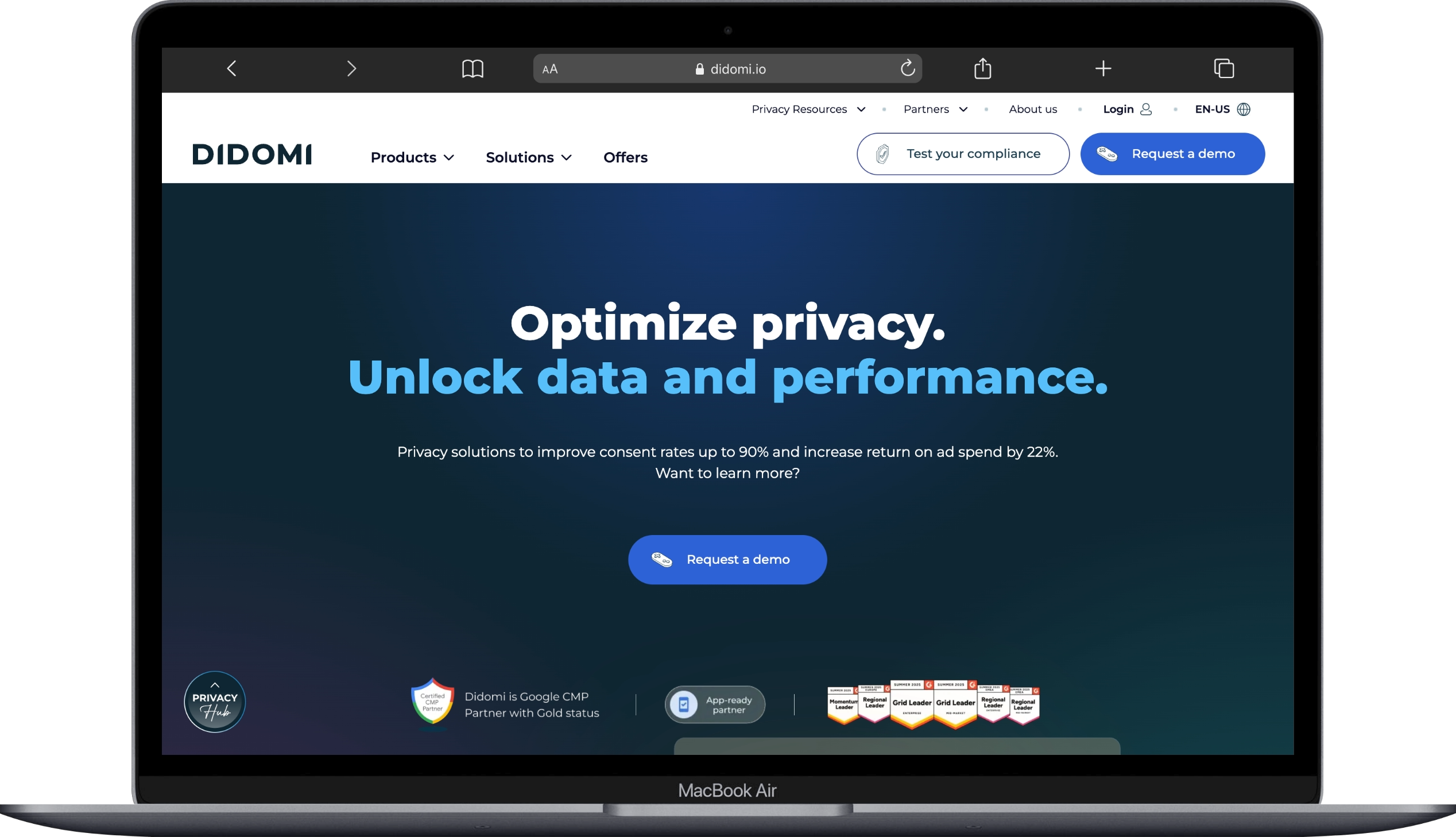
Didomi is a CMP designed for organizations operating in multiple countries. As with the other leaders, the platform offers compatibility with key market standards such as the IAB Transparency & Consent Framework or Google Consent Mode. It thus enables the deployment of consent management strategies adapted to multi-regulatory environments.
Although not available in self-service, the platform offers multiple configuration levels and integration systems, with specific support for implementation.
Didomi’s Key Strengths:
- Compliance with main international regulations (GDPR, CCPA/CPRA, etc.).
- Possible banner customization.
- Reporting and analytics to manage consent rates and banner performance.
- Support for specific implementations.
Overall Didomi’s G2 Rating: 4.5/5
Enzuzo
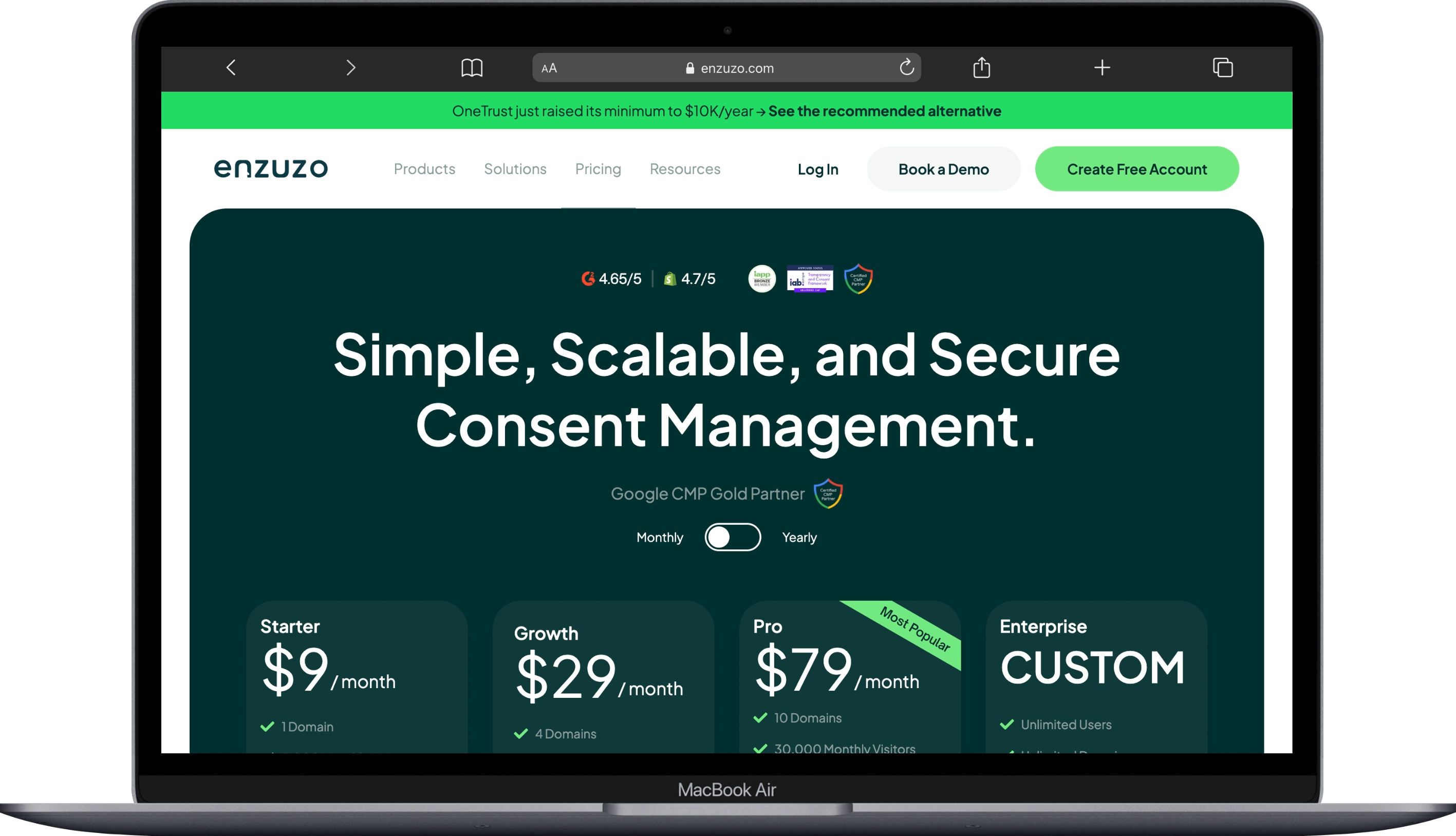
As with the previously mentioned CMPs, Enzuzo offers compatibility with key market standards such as Google Consent Mode and advertising ecosystem frameworks. However, the solution primarily targets growing companies looking to structure their privacy management without multiplying tools.
The platform provides features such as data mapping, user request management (DSAR), risk-based vendor management, and dashboards to manage the entire setup. Enzuzo also offers integration with GTM to connect consent choices to marketing and analytical tools.
Enzuzo’s Strengths:
- Compliance platform integrating consent management, data mapping, user requests (DSAR), and dashboards.
- Vendor management to track risks related to partners and third-party tools.
- Consent logs and detailed reporting to facilitate audits and track user preferences.
Overall Enzuzo’s G2 Review Rating: 4.6/5