Affiliates program
 Login
Login


At a time when cultural organizations are facing growing financial pressure and every communications dollar has to be justified, online consent is about far more than compliance with Quebec’s Law 25. It goes to the heart of the sector’s ability to measure performance, build lasting audience relationships and protect its economic model.
A 12-month study conducted by Axeptio, based on user behavior around cookie banners across the 199 websites in the Tuxedo Billetterie ecosystem (part of the iCible group), highlights a level of performance rarely seen in the cultural sector.
Three indicators were analyzed: interaction rate, consent rate and opt-in rate. The aim was to identify performance gaps and understand what drives them, whether that comes down to CMP (consent management platform) setup or to characteristics specific to each cultural organization.
Beyond the numbers, the analysis also sheds light on the digital maturity of Tuxedo's ticketing solution customers, which accounts for close to 40% of Quebec’s live entertainment ticketing market.
The Three Metrics That Matter Most in CMP Performance
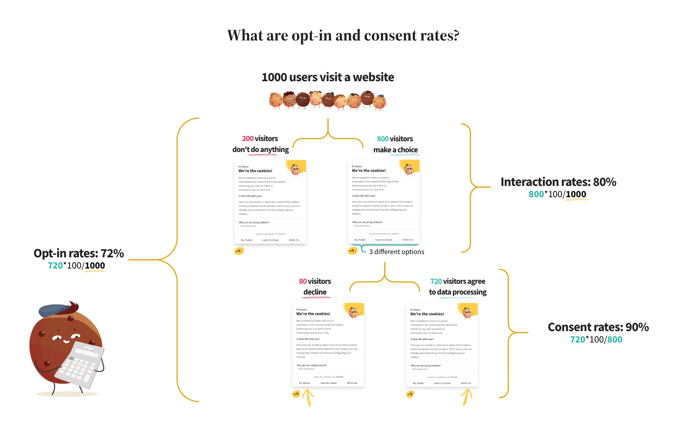
Three metrics are critical when assessing the performance of a consent banner: interaction rate, consent rate and opt-in rate.
The first measures the share of visitors who click on the banner and make a choice. The second shows, among those users, the proportion who agree to data collection. The third combines the first two and reflects the actual share of data that marketing teams are able to activate.
“Taken together, these three metrics make it possible to distinguish between setups designed purely for compliance and those that are genuinely effective from an operational and marketing perspective,” says Pierre Gagnon-Gingras, Customer Success Manager at Axeptio.
And because a visual often says more than words alone, here is an infographic offering a simplified view of these consent-related metrics:
High-performing Banners Are Built Into the User Experience
Interaction rate measures the proportion of visitors who engage with the banner and make a choice, whether that is to accept, reject or customize.
The strongest results were recorded on the ticketing websites of Petit Théâtre du Nord (82%), L’Anglicane at Espace DCL (80.5%) and FESP (Comité de spectacles de Fermont, 80.2%).
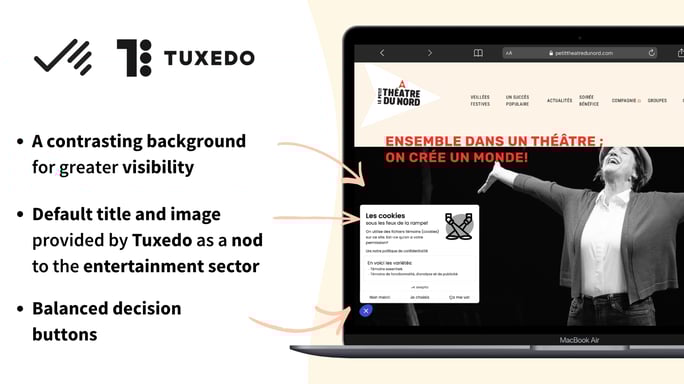
The analysis shows that the best-performing banners tend to blend naturally into the site’s visual universe, avoid overloading users with text and, in some cases, make effective use of color contrast. The custom title included in the default template provided by ticketing system vendor Tuxedo — “Cookies in the spotlight” — also helps extend the user experience and ties in neatly with the world of live performance.
Beyond visual design, this template also reflects sound structural choices in data management. In particular, it supports advanced features such as cross-domain tracking, which preserves continuity in user data when a journey spans multiple websites. With this kind of setup in place, organizations are better able to reconstruct the full user journey, assign value to actions and optimize marketing decisions.
Another common feature is symmetrical decision buttons, an approach recommended in UX best practice and included by default in the ticketing provider’s standard configurations. Giving equal visual weight to accept, reject and customize options is also strongly recommended under the GDPR, the European counterpart to Quebec’s Law 25.
In Some Segments, High Consent Rates Point to Strong Audience Trust
Consent rate measures the proportion of users who agree among those who interacted with the banner. It is a direct reflection of the relationship between an organization and its audience.
The contemporary dance organization Tangente (90.7%), Théâtre Desjardins (90.5%) and Agora de la danse (86,7%) posted some of the highest consent rates observed.
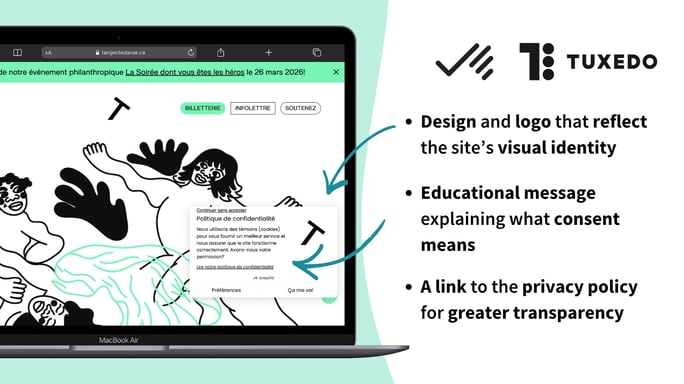
Dance organizations appear repeatedly in the top 10, including Tangente and Agora de la danse, as well as La Rotonde (86.3%). Even so, it would be too simplistic to treat artistic discipline as the sole explanation, since the wider analysis does not reveal any structural correlation between organizational type (such as multi-disciplinary or specialized in dance) and performance. What these organizations do appear to share, however, is a strong base of subscribers and members, along with an ongoing relationship with their community.
“At a time when data collection is met with growing caution from the public, this level of consent rate points to an already well-established relationship of trust between cultural organizations and their audiences."
Evelyne Boudreau VP Marketing and Digital Strategy at Tuxedo | iCible

Tuxedo’s Opt-in Rates are Significantly Above Sector Averages
Opt-in rate — the product of interaction rate and consent rate — is the most immediately useful metric for marketing teams, as it determines the actual volume of data available for analytics and targeting tools.
In the cultural sector, average opt-in rates are often 15 points lower than the cross-sector average, according to a study carried out across Axeptio’s client base by industry.
Pourtant, sur le périmètre de Tuxedo, plusieurs acteurs dépassent cette moyenne de 25 points, avec un taux d’opt-in record de 63,5% pour le Théâtre du Bic. Le site du théâtre Desjardins suit de près avec un taux d’opt-in de 61,2%.
And yet within the Tuxedo ecosystem, several organizations outperform that benchmark by as much as 25 points, with Théâtre du Bic posting a record opt-in rate of 63.5%. Next is the Théâtre Desjardins, with opt-in rates of 61.2%.
Among the top 10 CMP performances within Tuxedo Billetterie, the results cannot be explained by organization size, geographic location or the nature of the programming. In other words, whether the organization is a municipal theatre, a cultural nonprofit, an international festival or a gala operator does not appear to be a decisive factor.
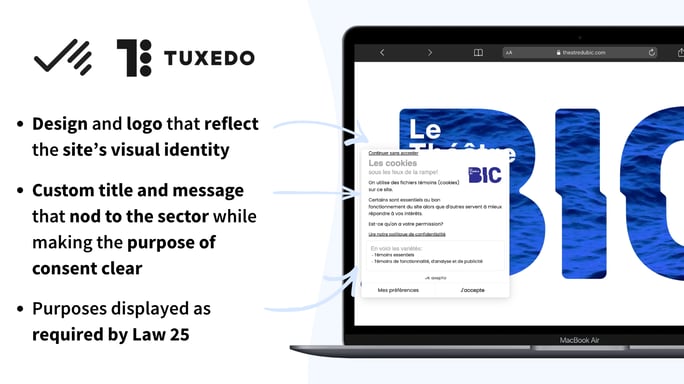
The differences observed seem instead to be tied to cookie banner design and to the overall consistency of the setup and user experience:
- whether the consent banner fits with, or clearly echoes, the organization’s visual identity;
- how clear the message is and how well the wording connects to the cultural sector;
- whether symmetry in user choices is respected;
- whether the banner appears at the right moment, without interrupting navigation too abruptly;
- and how clearly the information is explained.
Data Management Will Be a Key Challenge for Cultural Organizations in 2026
The quantitative analysis, together with discussions with Tuxedo’s experts, also made it possible to assess how well cultural organizations understand the data issues at stake.
Tuxedo represents around 40% of Quebec’s ticketing market, making it both a significant sample and a meaningful barometer of the sector’s digital maturity across the province.
“Many cultural organizations have limited marketing resources or legal support, and do not always make the connection between compliance with Law 25, proper CMP configuration that includes all relevant tags, and tracking budgets and ROAS (Return on Ad Spend) across their marketing campaigns. As a partner committed to the cultural sector, it is our role to educate and support organizations of all sizes so they can build these key capabilities and manage their advertising investments more responsibly and more effectively.”
Evelyne Boudreau VP Marketing and Digital Strategy at Tuxedo | iCible
The aim is also to help these organizations develop the right instincts, especially in cases where managing web tools is far from their core business.
“When an organization decides to invest in a Meta campaign and activates the advertising pixel, it should also automatically update the list of vendors displayed in the consent banner. An incomplete setup creates a compliance issue, but it also undermines campaign measurement and performance.
Pierre Gagnon-Gingras Customer Success Manager

“In an environment where marketing budgets are constrained, the ability to measure campaign performance accurately becomes critical. Before increasing ad spend, the first step is to make sure the CMP is properly set up,” Evelyne Boudreau adds.
When configuration is under control and the issues surrounding consent are well understood, the CMP becomes a reflection of the relationship and trust between cultural organizations and their audiences.
This study shows that Quebec’s cultural sector achieves consent levels above those observed elsewhere. That cannot be separated from the long-standing relationship between cultural organizations and their local communities. Existing trust appears to make audiences more willing to accept tracking technologies when they are presented clearly and explained properly.

.png?width=427&height=213&name=Miniature%20B2%20%C2%B7%20Version%20retenue%2c%20ajust%C3%A9e@2x%20(2).png)
.png?width=427&height=213&name=Interflora%20x%20Axeptio%20(1).png)