Affiliates program
 Login
Login


In 2026, web analytics platforms have had to absorb a surge of traffic from AI assistants and bots. On top of their core job of measuring audience and conversions, they now have to show they can tell human traffic from agent-generated traffic, meet tougher expectations around hosting and data sovereignty, accommodate the shift to server-side tagging, and interoperate cleanly with the rest of the marketing stack. All of it while honoring user consent, still the single biggest factor in how much traffic is observable and how good the resulting data is.
This comparison of the 6 best web analytics platforms in 2026 starts with the criteria that should actually drive the decision. We then look at Google Analytics (GA4), still the most widely deployed tool on the market, before turning to five alternatives: Piano Analytics, Eulerian, Matomo, Amplitude and Piwik PRO. We close on the role of consent and of the CMP in the quality and volume of measurement you can genuinely work with.

How to Choose a Web Analytics Platform in 2026
The usual feature-comparison grid no longer separates these platforms, because they all cover the dashboard basics well by now. What sets them apart is how well each one holds up when the collection environment itself is unstable. The arrival of AI agents, falling traffic to brand-owned sites, and consent requirements that shift depending on the data you want to analyze all now feed into the choice of an analytics platform.
Five criteria shape that choice in 2026: the ability to isolate meaningful traffic, how the tool behaves when consent is denied, the level of control over hosting, how it connects to a data warehouse or to activation use cases, and the operational load it puts on your teams.
How Reliable is Data Collection?
Collection reliability comes first. Look at how the tool handles signal loss caused by browsers, blockers and cookie restrictions, and now by traffic from AI assistants.
Vendors have documented that last point at length. Matomo introduced AI assistant tracking in version 5.5.0, then added a dedicated AI chatbot report in Matomo 5.8.0, released on March 4, 2026. Its reporting splits traffic into two categories: agents and chatbots crawling pages to build an answer, and human visitors arriving from a link cited in a conversational interface, treated as an acquisition channel in its own right. The March 2026 announcement makes the point that without visibility into this traffic, data becomes less reliable and less actionable, with knock-on effects on marketing attribution and conversion reporting.
Agent visits carry statistical signatures of their own (usually a single page, an unusual time on page, no path through the site), which skews bounce rate, time on page and conversion rates the moment they mix in with organic traffic. The number to watch therefore becomes human sessions rather than total sessions.
Accuracy also depends on the collection architecture. Google’s documentation positions server-side tagging as one answer to signal loss. The Google tag gateway for advertisers project extends the same logic by serving Google scripts from the site’s own first-party infrastructure rather than from Google domains, which ad blockers routinely flag. In May 2025, Cloudflare reported an average 11% uplift in observed signals among its early testers.
Consent Management and What It Does to Your Data
Consent has a direct effect on how much data you end up with. When a user declines, an analytics platform can do one of four things.
- Collect nothing. The tag never fires and the visitor is absent from reports. This is the default in most deployments, and what Consent Mode v2 does in basic mode.
- Model. Non-identifying signals are sent before consent and used to estimate the behavior of non-consenting users from that of consenting ones. This is the route Google took for GA4 with Consent Mode v2 in advanced mode, subject to the thresholds mentioned below. Modeling is conditional on event volume thresholds, as set out in Google’s documentation.
- Collect anonymously. The event is recorded with no persistent identifier. Piwik PRO documents three variants depending on how much traceability is retained: with cookies and session data, with session data but no cookie, and with neither. If the visitor consents later, the session switches to full measurement.
- Collect under an exemption. The tool really does collect, without prior consent, because its configuration takes it outside the scope of the requirement. Piano Analytics implements this through hybrid tracking with three modes (optin, exempt, optout), relying in part on masking the visitor_id property. Eulerian has published a configuration guide describing a “minimal collection” that replaces standard collection.
|
Behavior when consent is denied |
What you give up analytically |
Examples |
|---|---|---|
|
No collection |
Non-consented traffic disappears from reports, including from volume counts |
Consent Mode v2 basic, default configuration |
|
Modeling |
Data not exportable at event level, volume thresholds to clear, modeled share not identifiable in reports |
GA4 with Consent Mode v2 advanced |
|
Anonymous collection |
No distinction between new and returning visitors, no cross-session tracking, geolocation limited to country |
Piwik PRO |
|
Exempt measurement |
No activation, no joining to other datasets, no cross-domain tracking |
Piano Analytics, Eulerian |
The fourth case is the only one resting on a legal basis, which is why you have to look at the French regulator’s framework to know what it actually allows.
The criteria the CNIL sets out under Article 82 of the French Data Protection Act are available on this page. An exemption is generally paid for by giving up certain data points or processing operations. Which is why most platforms today combine two models: exempt or anonymous measurement to keep a complete view of audience, and full measurement after consent for attribution, personalization and marketing activation.
Hosting and data residency
Hosting shapes governance, data transfers, audit capability, and sometimes how readily a data project gets accepted internally. It weighs more heavily than it used to in RFPs from regulated sectors, public-sector bodies among them.

Matomo offers an On-Premise edition self-hosted on the customer’s own servers, under an open-source license, with a promise of 100% data ownership and the option to migrate in either direction between Cloud and On-Premise.
Piwik PRO lets you choose where the data sits when you set up the account, between public and private cloud, with European residency options and infrastructure certified to ISO 27001 and SOC 2.
Eulerian points to technology built and hosted in France, with no third party in its value chain, and notes in its configuration documentation that collected data remains its customers’ property.
Piano Analytics processes and stores data in the European Union. Worth noting that the parent company, Piano Software, has been US-owned since the acquisition of AT Internet in 2021, which sets its position apart from strictly European vendors.
Web Analytics vs Product Analytics vs Personalization
Audience measurement answers questions about traffic, content and channels.
Product analytics answers questions about behavior inside the product. Amplitude, for one, builds its product around funnels, retention, behavioral cohorts and journey analysis, with events rather than page views as the unit of analysis.
Personalization and journey optimization form a third family, where Beyable focuses on improving e-commerce conversion.
The distinction becomes decisive the moment a company wants to connect measurement to the rest of its data stack. Picking the right platform therefore starts with naming the objective: measuring an audience, steering a product, arbitrating a media mix, or personalizing a journey.
How Easily Can You Work with the Data?
How complex a tool really is comes down to how much you have to maintain around it to produce usable data. On this front, Piano’s answer is its reporting API and its export options (Data Query, Data Flow, Data Sharing via Snowflake). Matomo gives raw data access through its API and, On-Premise, read-only access to the MySQL database to feed a BI tool. Piwik PRO offers JSON, CSV and XML exports plus a BigQuery integration.
Why Google Analytics (GA4) is Still the Default Choice
According to W3Techs, as of August 2026 GA4 is used by 83.3% of sites whose analytics tool can be identified, or 47.9% of all websites, making it the most widely adopted analytics platform today by a wide margin.

What GA4 Does Well
A free standard tier, which explains much of that adoption. A site can measure its audience, its conversions and its acquisition channels with no dedicated budget line, something few alternatives match at the same level of functionality.
Native integration with Google’s advertising ecosystem. The link to Google Ads, Search Console and Merchant Center remains the clinching argument for acquisition teams: conversion imports, remarketing audience building and feeding the bidding algorithms all work with no integration effort.
The BigQuery export, available on the free tier. It exposes raw events and makes it possible to join them with CRM or logistics data. For data teams it is probably GA4’s most useful advance on Universal Analytics.
The event-based model, which brings web and mobile apps into a single environment. It fits multi-device journeys better, though it does mean rethinking the tagging plan, and having the skills on hand to do it.
Where GA4 Falls Short
Cardinality limits. GA4 caps the number of rows in the daily tables its reports draw on. Past that cap, surplus values are bundled into an “Other” row. Google’s documentation defines a high-cardinality dimension as any dimension exceeding 500 unique values per day, and sets a 50,000-value limit beyond which cardinality control applies. On a site with a large page inventory, or one making heavy use of custom dimensions, a meaningful share of traffic can end up unattributed.
Sampling. Exploration reports query raw event data and can be sampled past a certain event volume. Google publishes no official threshold, which makes it harder to judge how much confidence an analysis deserves.
Data retention. Standard properties keep event- and user-level data for 2 months by default, extendable to 14 months in the settings. Once expired, that data is gone for good. Paid Analytics 360 accounts allow longer windows, up to 50 months.
The BigQuery export ceiling on the standard tier, set at one million events per day for the daily export on free accounts, and 20 billion for paid Analytics 360 accounts. Sustained overruns can lead Google to suspend the export. The export is also not retroactive: it only picks up data collected once you have switched it on.
Consent Mode v2, the Key to How Consent, Modeling and Data Completeness Fit Together
Since March 2024, advertisers serving users in the EEA and the UK have had to pass consent signals to Google to keep access to measurement and ad personalization features. Consent Mode v2 added two parameters, ad_user_data and ad_personalization, to the existing analytics_storage and ad_storage..jpg?width=632&height=658&name=SW_COnsentMode_720x750FR%20(1).jpg)
Two implementation modes coexist, basic and advanced, and the choice between them has direct consequences for the data you get. In basic mode, no Google tag fires before consent: nothing is written, nothing is sent, and users who decline are absent from reports. In advanced mode, tags fire immediately but in a limited, cookieless state, sending non-identifying signals that make modeling possible. We go into how both modes work and what they mean for AdTech in our article Consent Mode v2: one year in, and a new paradigm for audience modeling.
For teams, this means decisions no longer rest on 100% of users: the consenting cohort becomes the statistical base for everything else. How well the CMP is implemented therefore feeds straight into how good the modeling is.
5 Google Analytics Alternatives
The five platforms below, all Axeptio partners, serve distinct audiences and needs. Here is where each one sits before we look at them in detail.
|
Platform |
G2 rating |
Best for |
Key points |
|---|---|---|---|
|
Piano Analytics |
4.4 / 5 |
Large international accounts, media and news publishers, public sector |
Exempt mode (hybrid tracking), no sampling, Snowflake foundation, ACPM accreditation, Data Query |
|
Eulerian |
4 / 5 |
Advertisers and online retailers who care about technology hosted in France |
Minimal collection without consent, multi-touch attribution modeling, server-side collection, built-in activation, French hosting |
|
Matomo |
4.2 / 5 |
Public sector, universities, healthcare, IT-led teams |
Built-in exemption compliance mode and published self-assessment, open source, free self-hosting, AI traffic reports |
|
Amplitude |
4.5 / 5 |
SaaS vendors, mobile apps and e-commerce platforms |
Consent required, event-based product analytics, behavioral cohorts, session replay, warehouse-native |
|
Piwik PRO |
4.5 / 5 |
Healthcare, banking and insurance, government, international groups |
Anonymous collection for non-consenting visitors and exemption mode, choice of hosting region, HIPAA compliance, integrated suite |
Piano Analytics

G2 rating : 4,4 /5
Key characteristics
- No sampling, and data that arrives fast. The vendor reports more than 4 trillion events processed per year, up to 120,000 events per second, with an average one-minute lag between an event and its availability in reports. On very high-traffic sites, this speaks directly to the cardinality limit described above with GA4.
- Snowflake foundation and data portability. Unsampled data is stored in Snowflake, with a Data Sharing option that opens up raw data without duplicating it, and a v3 reporting API for consuming any report from an external tool (Power BI, Tableau, Looker, ETL).
- Hybrid measurement and exemption. The three modes, optin, exempt and optout, keep audience measurement running when consent is not given. The vendor documents the configuration required to qualify for the consent exemption as defined by the CNIL, which relies in part on masking the visitor_id property in the data model.
- Certification. Piano is one of the platforms accredited by the ACPM, the body that certifies audience figures for French media.
- Data Query, an exploration tool for building granular datasets without writing code.
Best for: large international organizations, media and news publishers, public sector, and companies whose legal team expects the scope of collection to be documented precisely.
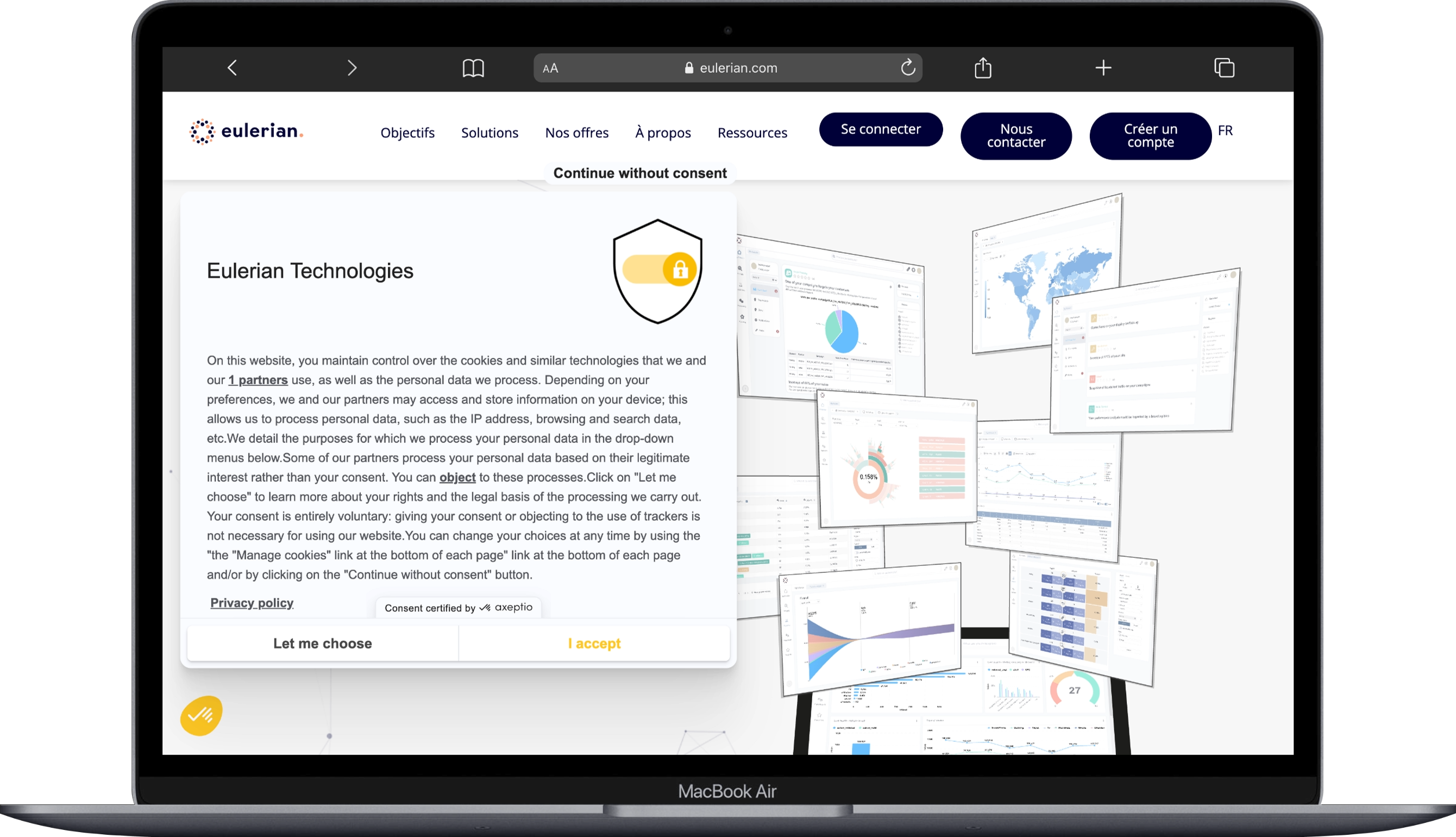
Eulerian
G2 rating : 4 /5
Key characteristics
- Analytics, attribution and activation in one environment. Attribution is where the company started: single-touch and multi-touch models, conversion deduplication across channels, real-time media performance reporting. Audiences built there can then be pushed to ad platforms, which saves the round trip between a measurement tool and an activation tool.
- Minimal collection when consent is absent. A configuration guide sets out a reduced collection mode that replaces standard collection when consent is not obtained, switching off certain data points and features grouped into four categories. Attribution and activation, the heart of the platform, still depend on consent, so this mode keeps audience measurement alive but not media optimization.
- Server-side collection. The architecture works around ad blockers and browser restrictions.
- Control of the chain and ownership of the data. The vendor points to technology built and hosted in France, with no third party involved in its processing chain, and data ownership retained by the customer.
- Certification. Eulerian is also accredited by the ACPM.
- A connector ecosystem into ad networks and media platforms.
Best for: advertisers and online retailers looking for a sovereign alternative across the whole measurement, attribution and activation chain, and for whom having the technology and the hosting located in France is a selection criterion.
Matomo
.png?width=2406&height=1382&name=Macbook-Air-matomo.org%20(1).png)
G2 rating : 4,2 /5
Key characteristics
- Free self-hosting. The On-Premise edition ships as open source and installs on the customer’s own infrastructure, which settles questions of data residency and non-EU transfers by design. A Cloud offer runs alongside, with migration possible between the two.
- A built-in compliance mode for the consent exemption. One setting disables the features incompatible with the exemption (heatmaps, session recordings, A/B testing, User ID, e-commerce tracking), and the vendor supplies a configuration checker. In April 2026 Matomo published a self-assessment table working through the CNIL’s July 2025 criteria point by point, which makes it the most up-to-date documentation in this selection on the subject.
- AI traffic reporting. Matomo was the first major vendor to ship dedicated reports for AI assistants and chatbots, included at no extra cost on Cloud and On-Premise.
- No sampling and no retention ceiling imposed by the vendor; the limit is whatever your chosen infrastructure can hold.
- Direct access to the data. Beyond the API, an On-Premise install allows read-only access to the MySQL database, which makes feeding a data warehouse or a BI tool straightforward with no intermediate connector.
- A broad feature set for an open-source tool: built-in tag manager, e-commerce tracking, heatmaps and session recordings as premium plugins, and an MCP server for querying the instance in natural language. Note that switching on the compliance mode disables some of these, which forces a trade-off between completeness of collection and depth of behavioral analysis.
Best for: public sector, universities, healthcare, organizations under data residency constraints, and IT-led teams.
Amplitude
G2 rating : 4,5 /5
Key characteristics
- A behavioral event model. Analysis runs on sequences of actions rather than page views, which makes it possible to build complex cohorts (users who did one thing but not another, on a given platform, within a given window) that are hard to build in an audience measurement tool.
- Depth on retention and journeys. Retention curves by entry cohort, path analysis, and correlation between feature usage and long-term retention are the core of the product.
- A broader platform. Session replay, web and product experimentation, in-app guides, and audience activation into media platforms and engagement tools all live in the same environment, off a single event source.
- Warehouse-native mode, which allows analysis on data held in Snowflake and elsewhere without duplicating datasets.
- An agent layer. In early 2026 the vendor introduced a conversational agent and MCP integrations with several market tools, aimed at surfacing anomalies.
- A free tier up to 2 million events a month, with access to the full platform according to the vendor.
- Consent required. The analysis rests on user profiles, individual cohorts and audience activation, which puts Amplitude outside the scope of the audience measurement consent exemption. Worth building into the measurement plan: usable volume tracks the opt-in rate of the site or the app directly.
Best for: SaaS vendors, mobile apps and e-commerce platforms.
Piwik PRO
G2 rating : 4,5 /5
Key characteristics
- Two possible regimes when consent is absent. The first is a setting aligned with the CNIL guidelines, chosen at account creation, which either collects without showing a consent form, or collects consent and limits itself to exempt data for those who decline. The second is anonymous collection in three variants depending on how much traceability is kept, switching to full measurement if the visitor consents later. The trade-offs the vendor documents: no distinction between new and returning visitors, geolocation limited to country, IP masked.
- Choice of hosting region, between public and private cloud, with European regions available and infrastructure certified to ISO 27001 and SOC 2.
- Sector compliance. The offer covers HIPAA requirements with a signed business associate agreement, which remains rare among analytics platforms and explains its footprint among healthcare organizations.
- An integrated suite bringing together Analytics, Tag Manager, Consent Manager and Data Activation under a single contract and a single data processing agreement. The vendor’s configuration guide assumes you use its own Consent Manager, though a third-party CMP such as Axeptio works too.
- Data out through an API, JSON, CSV and XML exports, a BigQuery connector, and an MCP server published by the vendor.
- An interface close to GA4’s, which cuts the training cost when teams move from one tool to the other.
Best for: healthcare, banking and insurance, government and local authorities, and international groups with per-region residency requirements.
Connecting Your CMP to Your Analytics Tool: Consent as a Confidence Indicator for Your Data
The CMP produces the signal every architecture described above depends on. How well it is implemented, and how well it sits in the user journey, therefore determine how much your numbers can be trusted.
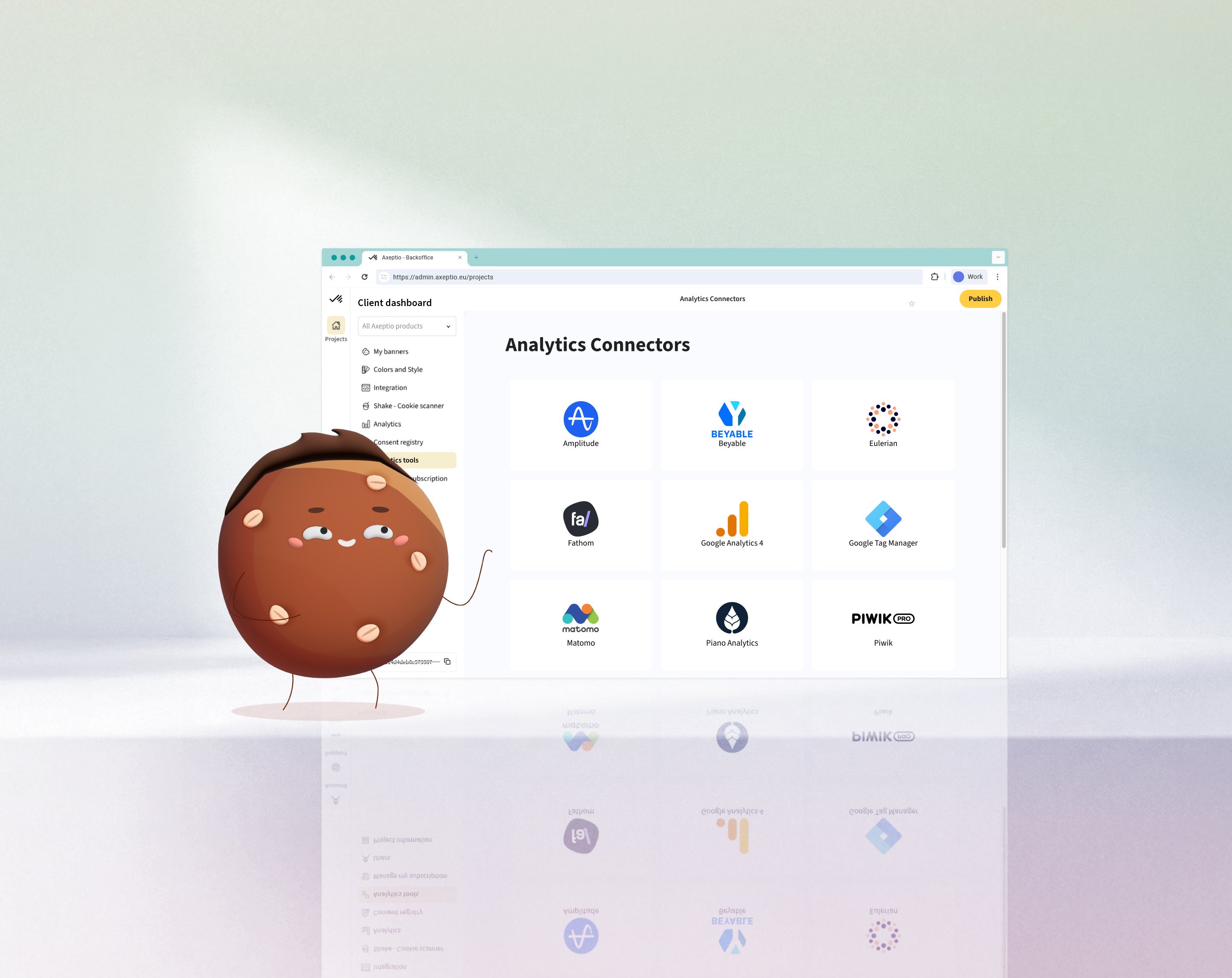
Going one step further, CMPs like Axeptio now offer analytics connectors that send consent events into the platforms covered above, where they land alongside your other KPIs.
The opt-in rate then becomes an indicator of representativeness, and by extension of the confidence an analysis deserves. It tells you what share of your real audience is feeding your reports. The same conversion report built on 35% or on 80% of traffic does not support an action plan with the same degree of certainty.
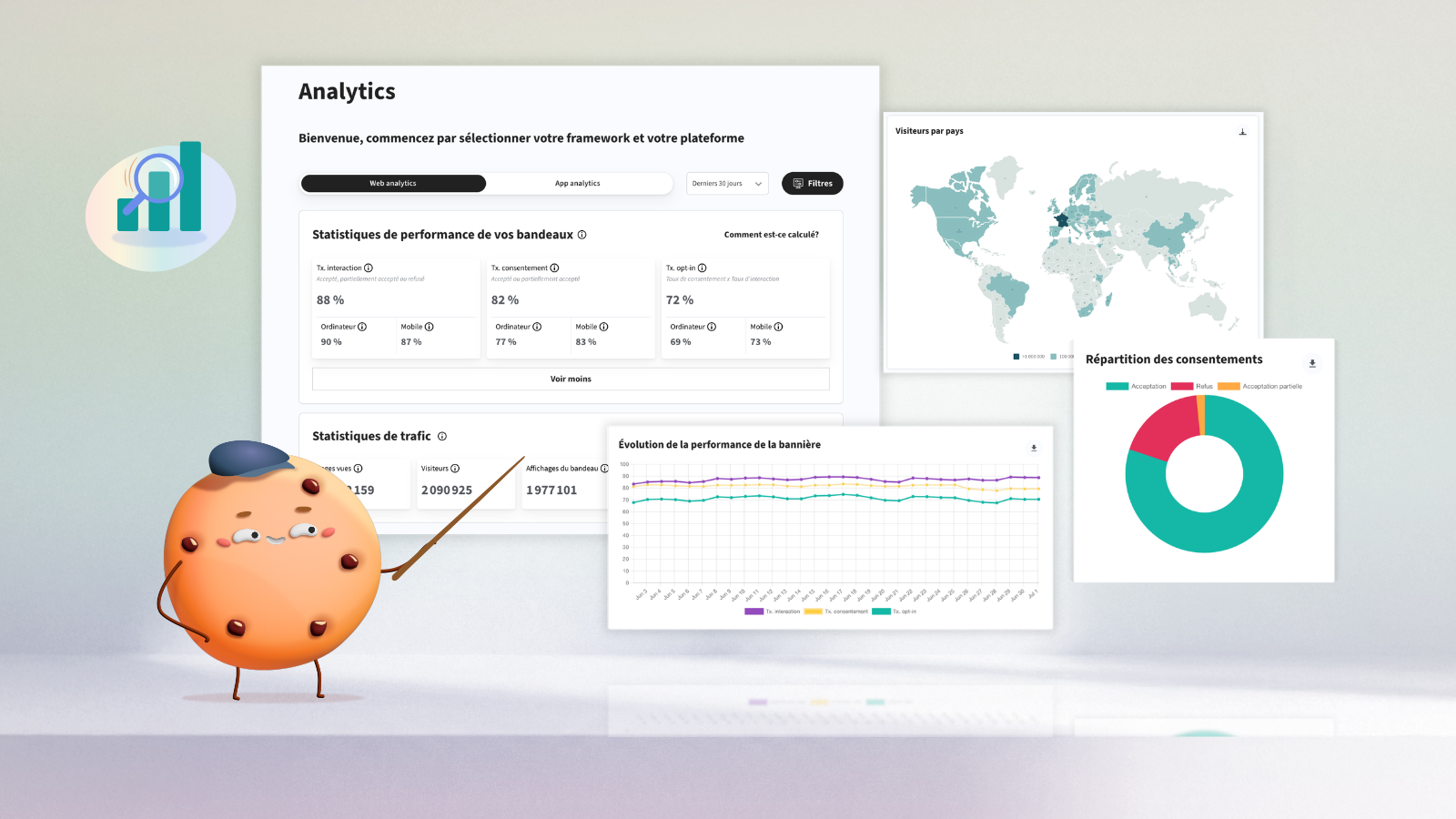
Once both datasets sit together, the analysis can go further: segment sessions by the choice expressed (accept, decline, partial consent), compare opt-in and opt-out segments on session duration or conversion rate, or pinpoint the sections and page types that produce the highest opt-in rates. That is the principle behind the shared Axeptio and Piano dashboard: switching on the Axeptio analytics connector feeds a template of nine consent KPIs into Piano Analytics, broken down by device, CMP version and display scenario.
Choosing a CMP therefore means choosing a component of your measurement stack, on the same footing as your analytics platform.
Axeptio is Gold-certified in Google’s CMP Partner program for Consent Mode v2, and supports the IAB TCF v2.3 standard as well as Microsoft’s equivalent mechanism (UET Consent Mode). Its integrations directory lists the connections available with the platforms on the market, including several of those covered here.
The signals described above are of course also available directly in the Axeptio dashboard, with new Analytics dashboards, which we unpack in a dedicated article.